

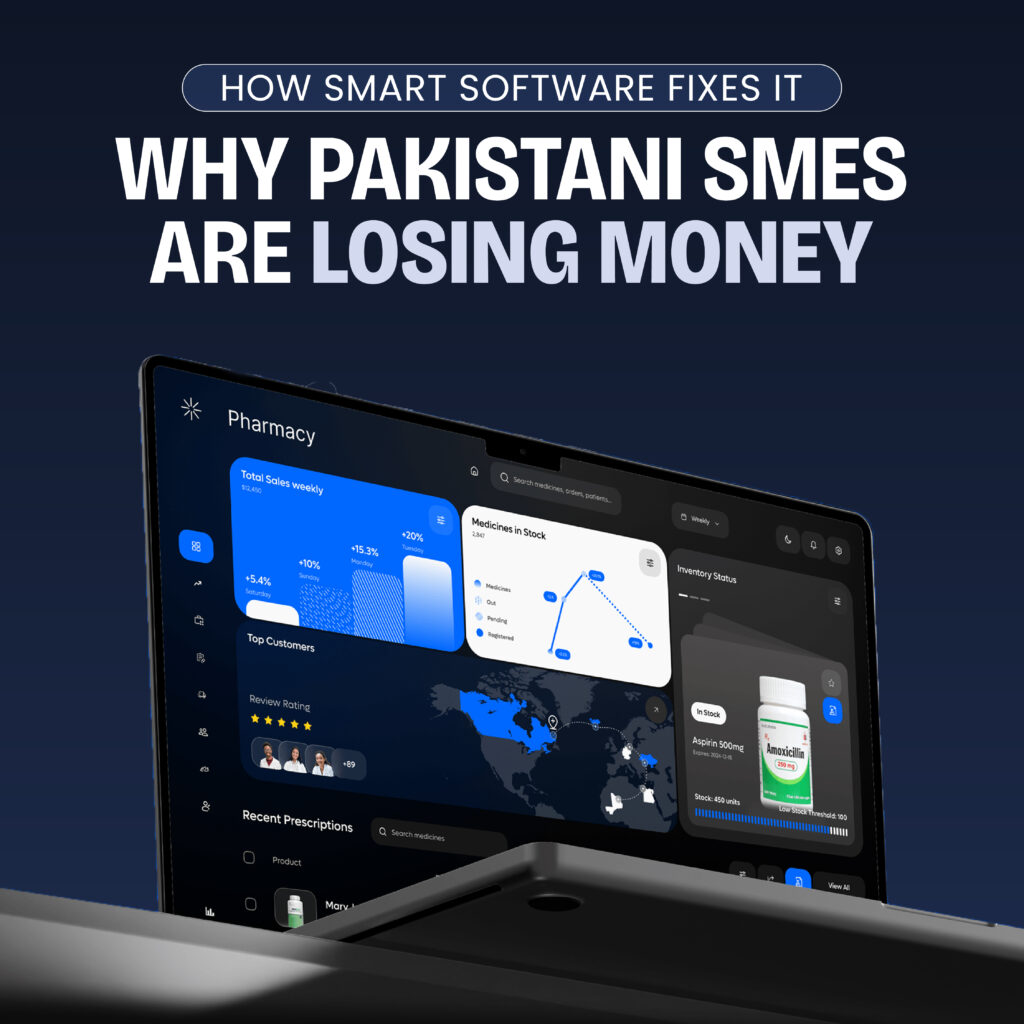
Introduction: The Silent Profit Leak in Pakistani SMEs
Across Pakistan, small and medium-sized enterprises (SMEs) are working harder than ever, but earning far less than they should. Business owners often blame rising costs, inflation, competition, or economic instability. While these are real challenges, there’s a much quieter and more dangerous issue eating away at profits every single day: lack of automation.
From manual payroll and attendance tracking to inventory errors, delayed reporting, and inefficient customer handling, the absence of automation for Pakistani SMEs has become one of the biggest reasons businesses struggle to scale profitably.
In today’s digital-first economy, relying on spreadsheets, registers, and disconnected tools is no longer sustainable. The good news? Smart software solutions are not only accessible but transformative.
This article breaks down where Pakistani SMEs are losing money, why automation is the solution, and how smart software fixes these problems permanently.
The Reality of SMEs in Pakistan Today
Pakistan’s SME sector accounts for:
- 90% of businesses
- 40% of GDP
- 80% of non-agricultural employment
Yet most SMEs still operate with:
- Manual workflows
- Paper-based records
- Disconnected systems
- Zero real-time insights
This operational gap creates inefficiencies that compound over time.
Common Industries Affected
- Retail & wholesale
- Manufacturing
- Distribution
- Travel agencies
- Real estate firms
- Scrap & recycling yards
- Service-based companies
No matter the industry, the problem remains the same: manual work leads to financial leakage.
Where Pakistani SMEs Are Losing Money Without Automation
1. Payroll Errors & Attendance Mismanagement
One of the highest hidden costs is inaccurate payroll.
Common issues include:
- Incorrect overtime calculations
- Ghost employees
- Late salary processing
- Manual attendance manipulation
These mistakes don’t just affect finances; they damage employee trust.
Without automation for Pakistani SMEs, payroll becomes a recurring source of loss and conflict.
Impact:
- Overpayments
- Compliance risks
- HR inefficiency
- Low morale
2. Inventory Mismanagement & Stock Loss
Whether it’s retail stock, raw materials, or scrap inventory, manual tracking leads to:
- Over-ordering
- Stockouts
- Theft & shrinkage
- Expired or damaged goods
For businesses handling physical inventory, the lack of automation for Pakistani SMEs directly translates into lost revenue.
Example:
A distributor who can’t see real-time stock levels often orders blindly, locking cash in excess inventory instead of growth.
3. Time Wasted on Repetitive Manual Tasks
Manual invoicing. Manual reporting. Manual approvals.
Each task may seem small, but together they:
- Waste hundreds of work hours monthly
- Slow decision-making
- Increase error rates
Time is money, and SMEs without automation for Pakistani SMEs pay a heavy price in lost productivity.
4. Poor Financial Visibility
Most SME owners don’t know:
- Their real-time profit margins
- Where money is leaking
- Which products or services are most profitable
Why? Financial data is scattered across spreadsheets, notebooks, and disconnected tools.
Without automated accounting and reporting:
- Decisions are based on guesses
- Growth becomes risky
- Cash flow problems remain invisible until it’s too late
5. Customer Experience & Revenue Loss
In today’s market, customer expectations are high.
Without automation:
- Leads aren’t followed up on time
- Customer data is lost
- Communication is inconsistent
This results in:
- Missed sales opportunities
- Poor retention
- Weak brand reputation
Automation for Pakistani SMEs ensures consistent, fast, and personalized customer interactions.
Why Many Pakistani SMEs Still Avoid Automation
Despite the benefits, many businesses hesitate. Here’s why:
❌ “Automation is too expensive”
Reality: Modern cloud-based software is affordable and scalable.
❌ “My business is too small”
Reality: Small businesses benefit the most from automation.
❌ “My staff won’t adapt”
Reality: User-friendly software reduces dependency on skilled labor.
❌ “Manual systems are working fine”
Reality: They’re only appearing to work—while silently leaking profits.
The cost of not adopting automation for Pakistani SMEs is far greater than the investment required.
How Smart Software Fixes These Problems
1. Automated Payroll & Attendance Management
Smart systems track:
- Attendance in real time
- Overtime accurately
- Leaves & holidays automatically
Benefits:
- Zero payroll errors
- Faster salary processing
- Transparent HR operations
This is one of the most immediate ROI wins for automation for Pakistani SMEs.
2. Real-Time Inventory Tracking
Modern inventory software provides:
- Livestock visibility
- Multi-location management
- Cost & margin tracking
For industries like retail, manufacturing, and scrap recycling, this eliminates guesswork and prevents losses.
3. Centralized Accounting & Financial Reporting
Smart accounting software:
- Automates bookkeeping
- Generates real-time reports
- Tracks expenses, income, and profit
With automation for Pakistani SMEs, owners gain complete financial clarity, allowing smarter, faster decisions.
4. Process Automation & Workflow Optimization
Automation reduces dependency on manual labor by:
- Streamlining approvals
- Automating reports
- Reducing repetitive tasks
Employees focus on growth, not paperwork.
5. Improved Customer & Lead Management
With CRM and automation tools:
- Leads are tracked automatically
- Follow-ups are timely
- Customer data stays organized
This directly increases conversions and customer retention.
Real-World Impact: What Automation Looks Like in Practice
Scenario: A Growing SME Before Automation
- Payroll errors every month
- Inventory discrepancies
- Delayed reporting
- Owner is overwhelmed with operations
After Automation
- Accurate payroll in minutes
- Real-time inventory control
- Instant financial reports
- Owner focuses on strategy & expansion
That’s the power of automation for Pakistani SMEs when implemented correctly.
Choosing the Right Automation Partner Matters
Not all software solutions are created equal.
Pakistani SMEs need:
- Local market understanding
- Scalable systems
- Customizable workflows
- Ongoing support
This is where working with an experienced digital partner makes all the difference.
Why Custom Software Is Better Than One-Size-Fits-All Tools
Off-the-shelf tools often:
- Lack of local compliance
- Don’t fit unique workflows
- Becoming limiting as businesses grow
Custom-built automation for Pakistani SMEs ensures:
- Perfect business fit
- Long-term scalability
- Higher ROI
The Future Belongs to Automated Businesses
Pakistan’s business landscape is changing rapidly.
SMEs that:
- Embrace automation
- Invest in smart software
- Optimize operations early
Will dominate their industries.
Those who delay will continue fighting rising costs, inefficiencies, and shrinking margins.
Final Thoughts: Automation Is No Longer Optional
Automation is not a luxury; it’s a survival tool.
For SMEs in Pakistan, automation for Pakistani SMEs is the difference between:
- Growth and stagnation
- Profit and loss
- Control and chaos
Smart software doesn’t replace people, it empowers them.
If you want your business to scale, compete, and thrive in today’s economy, automation is the smartest investment you can make.